Warehouses are changing from fixed conveyor systems toward more flexible automation. Autonomous mobile robots, commonly known as AMRs, are increasingly being used to move materials between storage, picking, production, and shipping areas.
Unlike traditional conveyor-based systems, AMRs can change routes and adapt to different workflows without rebuilding the entire facility. That flexibility is one reason mobile robots are attracting increasing attention from manufacturers and logistics operators.
The shift is also creating new requirements for the mechanical systems inside these vehicles. A mobile robot may be compact, but its drive system still needs to deliver sufficient torque, accurate movement, smooth acceleration, and reliable operation over long duty cycles.
Industry research from Interact Analysis has identified mobile robots as one of the fastest-growing applications for planetary precision gears, with the segment expected to become a major application area by 2026.
The Drive System Behind an AMR
The intelligence of an AMR gets most of the attention, but the vehicle still depends on a relatively simple physical principle: the motor must reliably turn electrical power into controlled movement.
The transmission between the motor and wheel affects several important characteristics:
Available wheel torque
Travel speed
Acceleration
Positioning accuracy
Mechanical efficiency
Noise and vibration
Overall vehicle size
For AMR manufacturers, these factors have to be balanced against battery capacity and available installation space.
A gearbox that is too large can reduce the space available for batteries, sensors, and electronics. A gearbox that is undersized may not provide enough torque during acceleration, ramp climbing, or when the robot carries a heavy load.
Why Planetary Gearboxes Fit Compact Mobile Robots
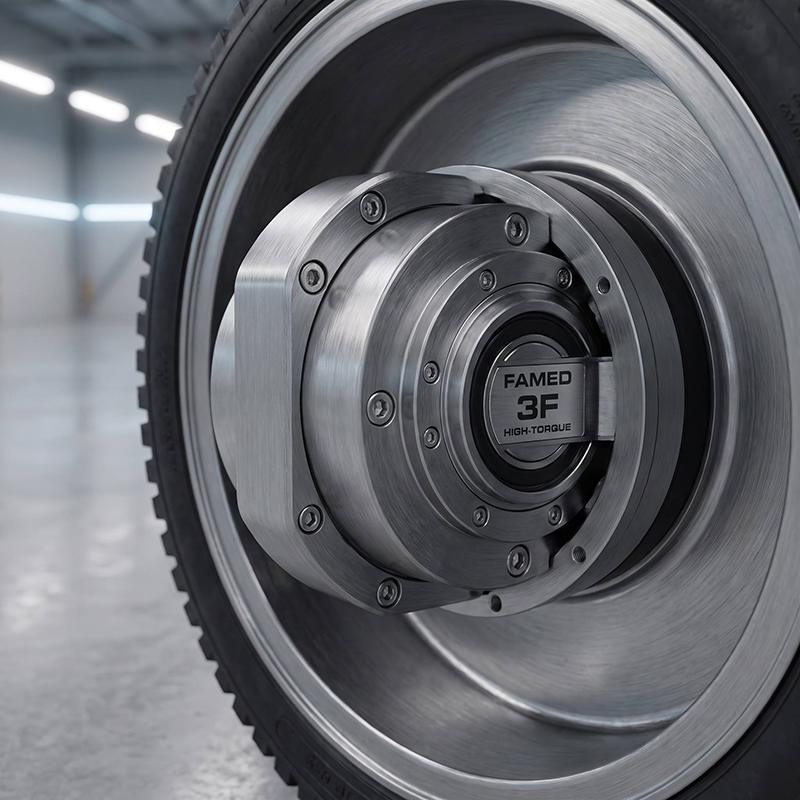
Planetary gearboxes are particularly suitable for applications where high torque needs to be delivered from a relatively compact package.
Their multiple-planet gear arrangement allows load sharing within the transmission while maintaining a relatively small overall size. This makes planetary transmission attractive for mobile equipment where space and weight are important design considerations.
For AMR applications, engineers may evaluate:
Torque density
The gearbox needs to deliver the required wheel torque without becoming unnecessarily large.
Reduction ratio
The ratio affects the relationship between motor speed, wheel speed, and available output torque.
Backlash
Low backlash can contribute to more predictable movement and positioning, particularly in systems performing precise docking or alignment.
Efficiency
Transmission losses matter in battery-powered equipment because they directly affect energy consumption.
Durability
Warehouse robots may operate for long periods with frequent starts, stops, and direction changes.
AMRs Are Moving Beyond Warehouses
The potential applications of mobile robots are not limited to traditional distribution centers.
Manufacturers are increasingly looking at autonomous material movement inside production environments. AMRs can transport components between workstations, deliver materials to assembly cells, move finished products, or connect different stages of a production process.
This creates opportunities across:
As these applications become more demanding, the mechanical transmission system needs to keep pace with the software and navigation technology controlling the vehicle.
Mechanical Reliability Still Matters
An AMR may use sophisticated navigation, sensors, and fleet-management software, but a failure in its drive system can still bring the vehicle to a stop.
For that reason, gearbox selection should be considered alongside the motor, wheel design, battery system, controller, and expected operating cycle.
For OEMs developing mobile robots, a transmission supplier can also contribute during the design stage by helping match the gearbox to the motor and mechanical layout.
Fenghua Transmission supplies precision planetary gearboxes, servo gearboxes, right angle gearboxes, RV reducers, harmonic reducers, and customized transmission solutions for automation equipment and motion-control applications.
As AMRs become more common in industrial and logistics environments, compact and reliable transmission systems will remain an important part of their mechanical architecture.
The next stage of warehouse automation will not be defined by software alone. The performance of the motor, gearbox, wheel, and control system must work together if mobile robots are to operate efficiently in real production environments.



 English
 Russian
 Spanish
 Italian
 Arabic
 Korean
 German
 Japanese
 Vietnamese
 Turkish