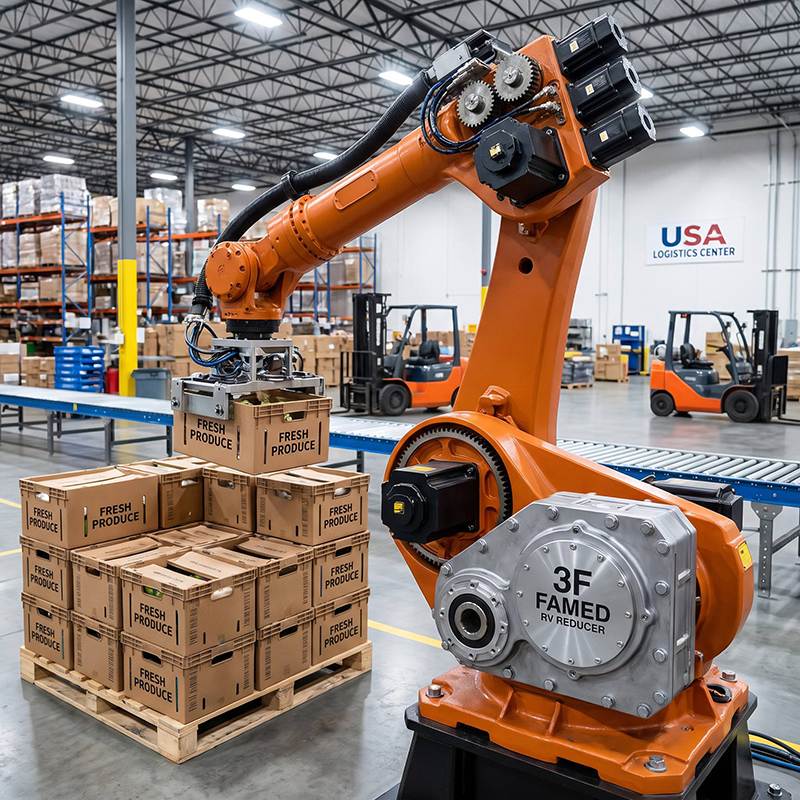
The U.S. industrial robotics market is showing renewed momentum, but the latest numbers point to an interesting shift in where automation is being adopted.
According to preliminary figures from the International Federation of Robotics (IFR), industrial robot installations in the United States increased 11% year over year to 38,000 units in 2025. Automotive remained the largest adopting industry, with 13,500 installations, but food manufacturing recorded one of the strongest increases, with robot adoption rising 30%.
The change is significant because it shows that industrial automation is moving beyond traditional automotive and metalworking applications. Food production, packaging, material handling, and other non-manufacturing operations are becoming increasingly important markets for robotics and motion-control equipment.
Why Food Manufacturers Are Turning to Automation
Food production presents a different automation challenge from automotive manufacturing.
Production lines often need to handle high volumes while maintaining consistent movement, hygiene standards, and product quality. Packaging formats can also change frequently, requiring machines to adapt without extensive mechanical modification.
Robotics and servo-driven automation can help manufacturers address these requirements.
Typical applications include:
Pick and place
Packaging
Palletizing
Machine tending
Sorting
Inspection
Material handling
Case packing
The growing use of automation in these areas creates demand for compact and reliable motion systems.
The Mechanical Side of Flexible Automation
Much of the attention surrounding robotics focuses on software, sensors, and control systems. On the factory floor, however, every programmed movement still has to be produced mechanically.
A servo motor generates motion, but the gearbox determines how that motion is transmitted to the machine.
This makes several gearbox characteristics important:
Backlash
Low backlash can help maintain positioning accuracy, especially in repetitive pick-and-place or packaging operations.
Torque Density
Compact equipment requires sufficient output torque without taking up unnecessary installation space.
Transmission Efficiency
Efficient power transmission becomes more important as machines operate for long production cycles.
Mechanical Rigidity
A rigid transmission system can help maintain stable movement during acceleration, deceleration, and changing loads.
Why Servo Gearboxes Matter in Packaging Equipment
Packaging machines often combine several types of movement within one production line.
A machine may use a servo-driven rotary axis for one operation and a linear or conveyor-driven mechanism for another. Different axes can therefore require different transmission characteristics.
Precision planetary gearboxes are well suited to servo applications where compact dimensions, high torque density, and accurate transmission are required.
Right-angle gearboxes offer another option when machine designers need to change the direction of power transmission because of space limitations.
For longer linear movements, rack-and-pinion systems can also be integrated with servo motors and gearboxes to create a flexible positioning system.
This combination gives machine builders more freedom when designing automated production equipment.
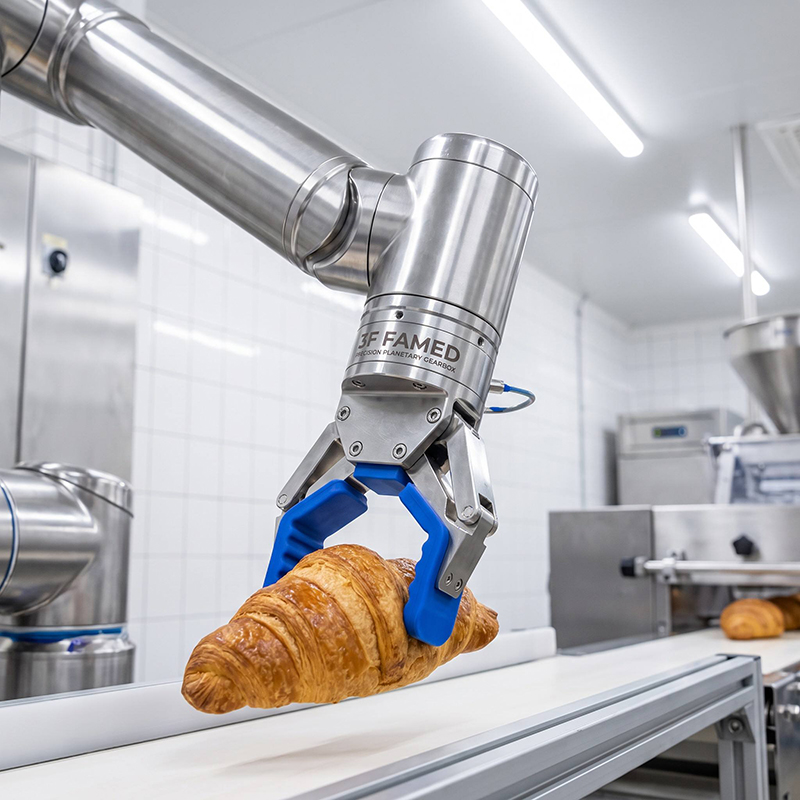
Automation Is Expanding Beyond the Traditional Factory
The latest U.S. robotics figures are a useful reminder that industrial automation is not limited to automotive assembly lines.
Food production, packaging, logistics, electronics, and other industries are becoming important users of industrial robots.
IFR's data shows that U.S. robot density reached 307 industrial robots per 10,000 manufacturing employees, while food-sector robot adoption rose sharply in 2025.
For equipment manufacturers, this creates a broader market for motion-control technologies and precision transmission components.
What This Means for Gearbox Suppliers
The growth of automation in new industries also changes what customers expect from gearbox manufacturers.
A standard product catalog remains important, but OEM customers increasingly need support with motor compatibility, mounting dimensions, reduction ratios, output configurations, and application-specific requirements.
The gearbox supplier therefore becomes part of the machine-development process.
Fenghua Transmission provides precision planetary gearboxes, servo gearboxes, right-angle gearboxes, harmonic reducers, RV reducers, motors, and precision rack-and-pinion solutions for industrial automation and precision machinery.
As robotics moves into more industries, the mechanical transmission system will remain an important part of making those machines practical, reliable, and repeatable.



 English
 Russian
 Spanish
 Italian
 Arabic
 Korean
 German
 Japanese
 Vietnamese
 Turkish