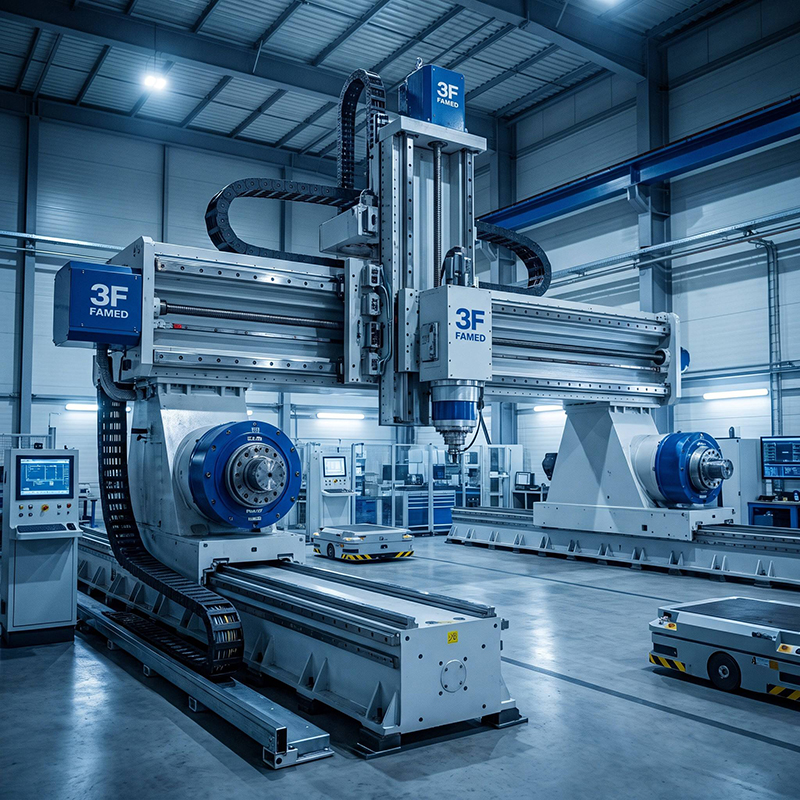
Not every automated application needs a six-axis robot.
For many manufacturing and material-handling tasks, a Cartesian robot with controlled movement along two or three linear axes can provide a simpler mechanical arrangement, predictable positioning, and efficient use of factory space.
That has kept Cartesian and gantry robots relevant as manufacturers continue to automate production processes. Recent market research estimates the global Cartesian and gantry robot market at about $7.33 billion in 2026, with the market forecast to reach approximately $16.9 billion by 2035.
The growth of these systems is creating a different set of requirements for motion-control components. Instead of focusing only on the robot arm, machine builders must consider the complete mechanical chain — from motor and gearbox to rack, pinion, linear guide, and positioning mechanism.
At Fenghua Transmission Technology (Jiangsu) Co., Ltd., we see this shift creating new requirements for precision motion components. As Cartesian and gantry systems become more widely used, machine builders are paying closer attention to the complete mechanical chain rather than the robot structure alone — from the servo motor and precision gearbox to the rack and pinion, linear guide, and positioning mechanism. The compatibility and performance of these components can directly influence the accuracy, stability, and service life of the finished machine.
Why Cartesian Robots Remain Attractive
A Cartesian robot moves along predefined linear axes.
This straightforward architecture can be advantageous when the application requires repetitive movement within a defined working envelope.
Common applications include:
Compared with more complex robotic structures, Cartesian systems can also make the mechanical layout easier to understand and maintain.
But simplicity does not mean that precision requirements are low.
The Transmission System Determines Motion Quality
A servo motor provides the power, but the transmission system determines how that power reaches the moving mechanism.
In a Cartesian or gantry system, the gearbox may be used to reduce motor speed and increase available torque. The resulting movement depends on the combination of gearbox backlash, mechanical rigidity, gear accuracy, and the characteristics of the linear drive.
For applications requiring high positioning accuracy, these factors become especially important.
A small amount of mechanical clearance can translate into positioning errors at the end of a long axis.
Rack and Pinion Systems for Longer Travel
Rack-and-pinion transmission can be useful when the machine requires relatively long linear travel.
Unlike a conventional ball screw, a rack system is not limited by screw length in the same way. This makes it attractive for larger automation equipment and long-axis positioning systems.
The challenge is maintaining accurate and repeatable movement over the entire travel distance.
Gear accuracy, backlash, mounting precision, and the rigidity of the machine structure all influence the final result.
This is where precision rack-and-pinion technology becomes an important part of the motion system rather than simply a mechanical accessory.
Where Gearboxes Fit Into Cartesian Automation
The gearbox is often selected according to the requirements of the servo motor and driven axis.
A precision planetary gearbox can provide:
Right-angle gearboxes can be useful when the motor needs to be positioned perpendicular to the driven mechanism.
For machine builders, the choice between an inline planetary gearbox, right-angle reducer, or another transmission structure depends on the available space, required torque, speed, positioning accuracy, and overall machine architecture.
Moving Toward More Integrated Motion Systems
As automation equipment becomes more sophisticated, individual motion components are increasingly being designed as part of a complete system.
A machine may combine:
Servo Motor → Precision Gearbox → Rack & Pinion → Linear Axis
or:
Servo Motor → Right-Angle Gearbox → Rotary/Linear Mechanism
The performance of the final machine depends on how well these components work together.
For this reason, equipment manufacturers are paying greater attention to suppliers that understand both the transmission component and its application.
What Equipment Builders Should Consider
When selecting transmission components for a Cartesian or gantry system, engineers should look beyond the nominal reduction ratio.
Important factors include:
1. Load and acceleration
The gearbox needs sufficient output torque for both the static load and acceleration requirements.
2. Backlash
Low backlash is particularly important when the machine must repeatedly reach a precise position.
3. Rigidity
A rigid transmission system helps reduce movement caused by changing loads and acceleration forces.
4. Travel distance
Long-axis applications require careful consideration of rack accuracy, alignment, and mechanical structure.
5. Motor compatibility
The gearbox must match the selected servo motor in terms of mounting, torque, speed, and inertia.
6. Operating cycle
Continuous industrial operation places different demands on the transmission compared with intermittent laboratory equipment.
The Next Step for Precision Automation
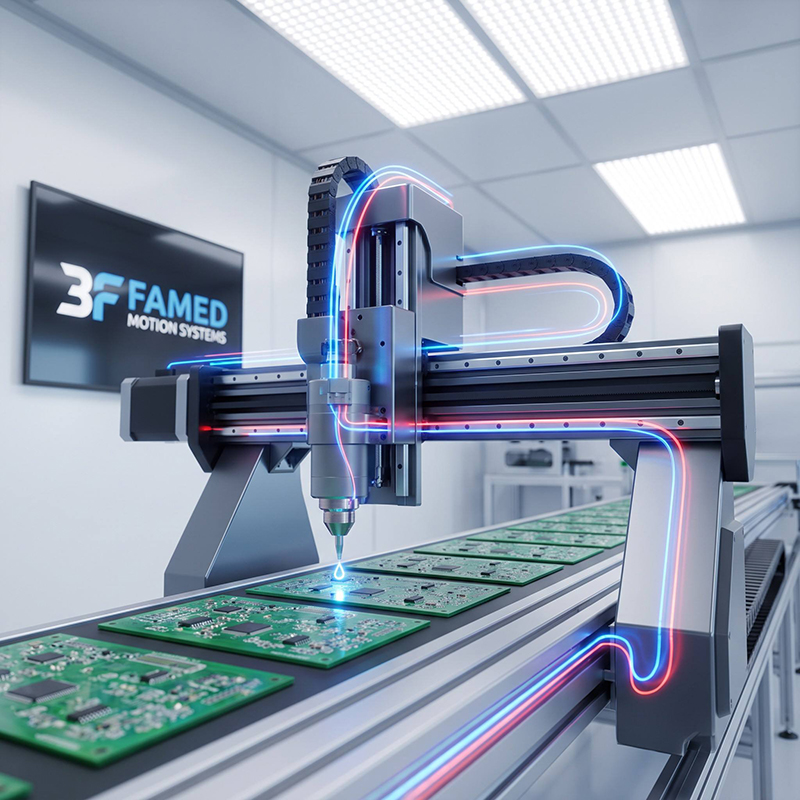
Cartesian and gantry robots may have a relatively straightforward mechanical architecture, but their performance still depends heavily on the quality of the motion components underneath the control system.
As manufacturers continue to automate material handling, assembly, inspection, and production processes, the relationship between servo motors, precision gearboxes, rack-and-pinion systems, and linear motion components will become increasingly important.
For transmission manufacturers, this creates an opportunity to provide more than individual components. The ability to understand how a gearbox interacts with the complete motion system can become just as valuable as the gearbox itself.
Fenghua Transmission provides precision planetary gearboxes, right-angle gearboxes, harmonic reducers, RV reducers, precision rack and pinion systems, motors, and linear motion products for industrial automation and precision machinery.



 English
 Russian
 Spanish
 Italian
 Arabic
 Korean
 German
 Japanese
 Vietnamese
 Turkish